< all news
Messages from the ESG Festival: AI as a Driver of Sustainability and Growth
27. October 2025.
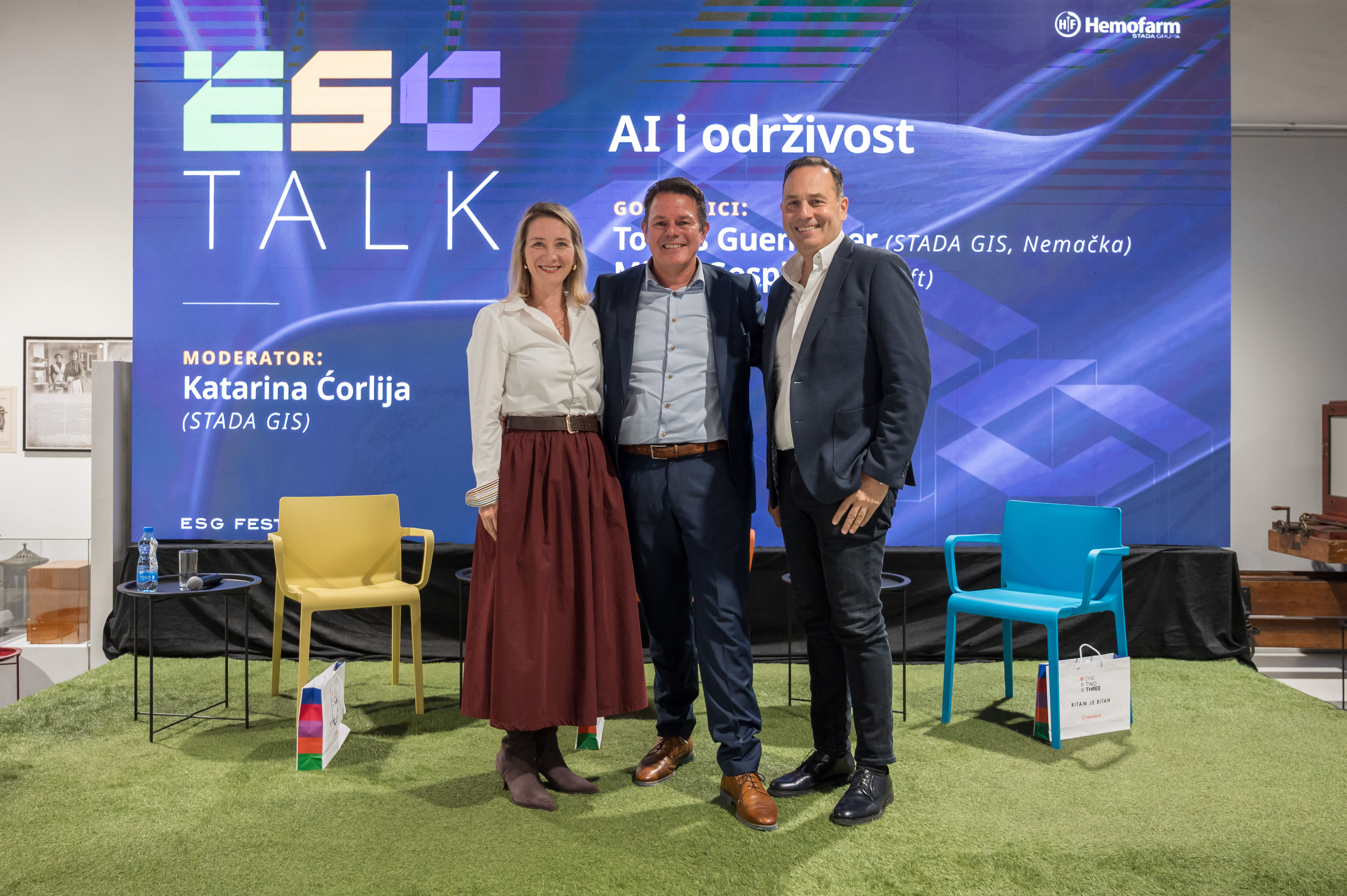
At Hemofarm’s second ESG Festival, the panel “Artificial Intelligence and Sustainability” highlighted the message from Tobias Günther, Vice President for IT at STADA Group, on how artificial intelligence accelerates the path toward sustainable and competitive business models in the pharmaceutical industry.
Günther emphasized that over the past 18 months, STADA has trained more than 4,000 employees and integrated AI tools across key business functions — from production and supply chain to finance and marketing.
“Our ambition is to democratize AI — to enable 5,000 to 6,000 employees who work with information to use intuitive tools every day that enhance efficiency and quality. The true value comes from scale and adoption,” he said.
Speaking about the impact on sustainability, Günther highlighted practical benefits: faster product development, higher quality standards, and waste reduction through smart energy systems, predictive maintenance, and better data utilization.
“When AI takes over routine tasks, people can focus on activities that create greater value — and that ultimately translates into better care for patients,” Günther noted.

As the next steps, he pointed to deepening AI implementation in production and supply chain, as well as expanding best practices through standardization and measuring sustainability impact. Current pilots cover finance, IT, regulatory, and quality departments, while in production the focus is on process optimization and predictive maintenance. On the commercial side, the goal is to improve communication with pharmacies and distributors.
He particularly emphasized Serbia’s importance in STADA Group’s AI ecosystem.
“Serbia is a large and dynamic market with a highly developed IT sector and skilled young professionals. A significant portion of our team and solutions originates right here, in the Serbia Competence Center. It’s a base from which solutions can be quickly scaled to the region,” Günther stressed.
On the topic of a “human-centric” approach, Günther emphasized that responsible use of technology must remain in human hands:
“Laws are important, but the culture of responsibility is built by us — experts and users. Technology must serve people, not the other way around. That’s why responsible professionals must hold key positions in tech companies, and everyone involved in digital transformation shares this responsibility. What makes the AI approach truly ‘human-centric’ is not only laws and regulations, but the responsibility of all who use this technology. Technology should serve humanity — not make humanity its servant.”
The panel also discussed the roles of digital assistants in daily work and the next phase of development toward more autonomous AI agents, confirming STADA’s direction — moving from operational efficiency toward responsible, intelligent automation.
Tobias Günther’s messages from the ESG Festival clearly define AI as a strategic accelerator of sustainability, efficiency, and quality in the pharmaceutical industry. Through extensive employee training, systematic technology integration, and a strong development foundation in Serbia, STADA is laying the groundwork for long-term, responsible growth.